2010 FIFA WC Final: How Iniesta’s 116th-Minute Goal Made Spain World Champions
Ask ten fans about the 2010 FIFA WC Final and you’ll hear the same image: Iniesta lashing the ball into the net. The rest of the story fades — the 14 yellow cards, Robben’s two missed breaks, and the quiet tribute under Iniesta’s shirt. This guide rebuilds the whole night in one place, with verified stats, primary sources, and every moment that mattered.
Quick Answer: What Was the Score in the 2010 FIFA WC Final?
Spain beat the Netherlands 1-0 after extra time to win the 2010 FIFA WC Final at Soccer City, Johannesburg, on 11 July 2010. Andrés Iniesta scored in the 116th minute, and captain Iker Casillas lifted Spain’s first World Cup trophy.
Where and When Was the 2010 FIFA WC Final Played?
South Africa staged the 2010 FIFA World Cup, the first edition on African soil. The final landed at Soccer City in Johannesburg, a colossal bowl on the edge of Soweto. England’s Howard Webb refereed the 2010 FIFA WC Final in front of a global TV audience in the hundreds of millions.
Key facts:
- Date: Sunday, 11 July 2010
- Venue: Soccer City (FNB Stadium), Johannesburg
- Attendance: 84,490
- Referee: Howard Webb (England)
- Match ball: Adidas Jabulani
Nelson Mandela, aged 91, waved to the crowd during the closing ceremony. The vuvuzela hum that defined the tournament hit its loudest note that night.
How Did Spain and the Netherlands Reach the Final?
Both sides earned the 2010 FIFA WC Final in opposite styles. Spain lost their opening game and still won the trophy — a first in World Cup history.
Spain’s route:
- Group H: 0-1 vs Switzerland, 2-0 vs Honduras, 2-1 vs Chile
- Round of 16: 1-0 vs Portugal
- Quarter-final: 1-0 vs Paraguay
- Semi-final: 1-0 vs Germany
David Villa scored five of Spain’s eight tournament goals. All four knockout wins finished 1-0, with zero goals conceded after the group stage.
Netherlands’ route:
- Group E: 2-0 vs Denmark, 1-0 vs Japan, 2-1 vs Cameroon
- Round of 16: 2-1 vs Slovakia
- Quarter-final: 2-1 vs Brazil
- Semi-final: 3-2 vs Uruguay
Bert van Marwijk’s side arrived with a perfect record. Wesley Sneijder matched Villa’s five goals and carried the Oranje’s biggest attacking threat.
Lineups: Who Started the 2010 FIFA WC Final?
Both coaches kept the XIs that won their semi-finals. Vicente del Bosque trusted his Barcelona-based spine; van Marwijk paired two holding midfielders behind Sneijder.
Spain (4-2-3-1): Iker Casillas (c) — Sergio Ramos, Carles Puyol, Gerard Piqué, Joan Capdevila — Sergio Busquets — Xavi, Xabi Alonso — Andrés Iniesta, Pedro Rodríguez, David Villa.
Netherlands (4-2-3-1): Maarten Stekelenburg — Gregory van der Wiel, John Heitinga, Joris Mathijsen, Giovanni van Bronckhorst (c) — Mark van Bommel, Nigel de Jong — Arjen Robben, Wesley Sneijder, Dirk Kuyt — Robin van Persie.
Cesc Fàbregas and Fernando Torres started on Spain’s bench. Both would shape the finish.
First Half: Why Did the De Jong Challenge on Xabi Alonso Spark Outrage?
Nigel de Jong caught Xabi Alonso in the chest with a high boot before the half-hour mark. Webb produced only a yellow card, a decision that still fuels debate today. Mark van Bommel also escaped repeated punishment as the Dutch targeted Spain’s midfielders.
Spain kept the ball and pushed forward, yet both teams went in level at 0-0. The pattern held: possession for La Roja, resistance from the Oranje.
Arjen Robben vs Iker Casillas: The Saves That Changed Everything
Robben raced clean through in the 62nd minute. Casillas spread his frame and blocked with his right leg. Eleven minutes later, the Bayern Munich winger broke free again — and Casillas’ boot turned the ball away once more.
Those two stops kept Spain alive. Remove either one, and the Dutch win the World Cup. Instead, Spain stayed level and grew stronger.
The 116th-Minute Goal: How Did Iniesta Win the 2010 FIFA WC Final?
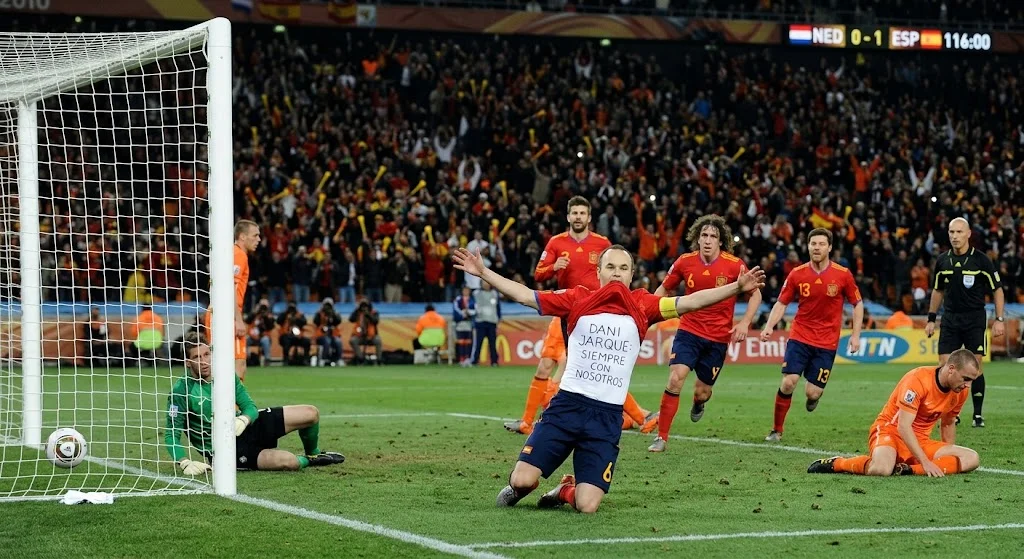
John Heitinga collected a second yellow card in the 109th minute, leaving the Netherlands with ten men. Seven minutes later, Fernando Torres laid the ball into Cesc Fàbregas’ path. Fàbregas squared it, and Iniesta hammered a rising shot past Maarten Stekelenburg.
The strike settled the 2010 FIFA WC Final 1-0.
Goal breakdown:
- Minute: 116 (extra time)
- Scorer: Andrés Iniesta
- Assist: Cesc Fàbregas
- Finish: First-time right-foot strike from inside the box
Iniesta pulled up his jersey to reveal “Dani Jarque: siempre con nosotros” — a tribute to the Espanyol captain who died of a heart attack in August 2009. It remains one of the most powerful celebrations in World Cup history.
Why Did the 2010 FIFA WC Final See a Record 14 Yellow Cards?
Webb booked players 14 times — nine cards for the Netherlands and five for Spain. Heitinga’s second booking produced the only dismissal. No other World Cup final has come close to that count.
Van Marwijk’s plan leaned on stopping Iniesta and Xavi by any means. The fouls disrupted Spain’s rhythm but could not stop the winning goal. Webb later admitted in interviews that he could have managed the night better — an honest reflection on the hardest 120 minutes in football.
2010 FIFA WC Final by the Numbers
Here are the key stats, per FIFA’s official match report:
| Stat | Spain | Netherlands |
|---|---|---|
| Goals | 1 | 0 |
| Possession | 63% | 37% |
| Shots | 16 | 13 |
| Yellow cards | 5 | 9 |
| Red cards | 0 | 1 |
Spain controlled the ball and created the cleaner chances. Casillas’ two saves and Stekelenburg’s own stops kept the scoreline tight until the 116th minute.
Why Does the 2010 FIFA WC Final Still Define Spanish Football?
The night changed Spain’s place in the game for good:
- Spain became the eighth nation to win the World Cup.
- La Roja became the first European side to win the trophy outside Europe.
- The final was the first since 1978 without Brazil, Germany, or Italy.
- Euro 2008, the 2010 World Cup, and Euro 2012 formed a treble no men’s team has matched.
- Iker Casillas won the Golden Glove; Diego Forlán took the Golden Ball; Thomas Müller claimed the Golden Boot on the assists tiebreaker ahead of Villa and Sneijder.
The Xavi–Iniesta axis peaked on the biggest stage. Tiki-taka stopped being a debate and became the standard every academy wanted to copy.
How Painful Was the Loss for the Netherlands?
Third time, same wound. The Dutch lost finals in 1974 (Johan Cruyff and Total Football), 1978, and now 2010. No nation has played more World Cup finals without winning one.
Sneijder’s five goals earned nothing, and Robben’s misses followed him for years. The 2010 FIFA WC Final remains the closest the Oranje have come to the trophy — and they are still chasing their first title today. Captain Giovanni van Bronckhorst ended his international career that very night.
How Did the 2010 FIFA WC Final Change Football?
The match pushed possession football to its peak. Clubs and national teams rebuilt their midfields around Spain’s triangles, and pressing systems evolved specifically to break tiki-taka. Modern positional play traces a straight line to this era.
The final also closed Africa’s first World Cup on a high. Soccer City, the vuvuzelas, and Mandela’s wave gave the tournament a legacy that outlived the month. Refereeing bodies still cite the 14 bookings whenever they discuss protecting creative players.
FAQs About the 2010 FIFA WC Final
Q1: Who won the 2010 FIFA WC Final? A: Spain beat the Netherlands 1-0 after extra time. Andrés Iniesta scored the only goal, and Iker Casillas lifted the trophy as captain.
Q2: Who scored the winning goal and when? A: Andrés Iniesta, in the 116th minute of extra time. Cesc Fàbregas provided the assist, and the shot beat Maarten Stekelenburg.
Q3: Where was the final played? A: At Soccer City in Johannesburg, South Africa, on 11 July 2010, in front of 84,490 fans.
Q4: How many cards did Howard Webb show? A: Fourteen yellow cards — nine for the Netherlands, five for Spain — plus a red for John Heitinga after a second booking. All are records for a World Cup final.
Q5: Why did Iniesta show his shirt after scoring? A: His undershirt read “Dani Jarque: siempre con nosotros,” a tribute to his late friend, the Espanyol captain Dani Jarque.
Q6: Was this Spain’s first World Cup title? A: Yes. Spain became the eighth champion in men’s World Cup history, sitting between their Euro 2008 and Euro 2012 wins.
The Last Word: Relive the 2010 FIFA WC Final
One kick in the 116th minute turned a golden generation into immortals and broke a nation’s heart for a third time. That is why this match still gets replayed every summer.
Where were you when Iniesta struck? Drop your memory in the comments, share this guide with a fellow football fan, and read our Euro 2012 final breakdown next to complete the Spain story.